


If you run ads in niches that technically violate platform policies—nutra, gambling, crypto, finance with aggressive offers—you will eventually hit the same wall: how to show the moderator a harmless page and the real buyer the actual offer? The answer is cloaking.

Let’s break down how this technique works from the inside, why filtering logic alone isn't enough, and what role the quality of proxies—through which the traffic passes—plays in this chain.
What Happens Inside a Flow
A "flow" in cloaking is a sequence of several links: ad → landing page/cloaking script → one of two versions of the site. When someone clicks a link, the script analyzes the request in a fraction of a second and decides where to send it.
What the system checks when making a decision:
IP address type: residential, data center, or cloud;
User-Agent and signs of automated browsers without a real user behind the screen;
Presence and accuracy of the referrer: ad click or direct visit;
Geolocation, interface language, device type, and model;
Matches with databases of known bots, anti-fraud services, and specific platform moderator IP addresses.
If even a few signs point to a review, a "white page" opens: a clean, fully legal page that will pass any moderation. If the request resembles a living human from the target audience, the real landing page with the offer is displayed.
Why a Flow Cannot Be Set Up Once and Forgotten
Filtering logic that worked perfectly six months ago might not work at all today—platforms are constantly updating their anti-fraud systems, and bots have learned to mimic the behavior of real people: moving the cursor, scrolling the page, pausing on elements. Because of this, a flow requires constant attention:
IP addresses must be regularly changed and rotated so that suspicious activity history does not accumulate on a single address;
Offers should be isolated from each other—if one address gets banned, it should not drag the rest of your campaigns down with it;
Domains and landing pages should ideally be kept in different, technically disconnected infrastructures so that one leak doesn't crash everything.
Why Cloaking Doesn't Work Without Clean Proxies
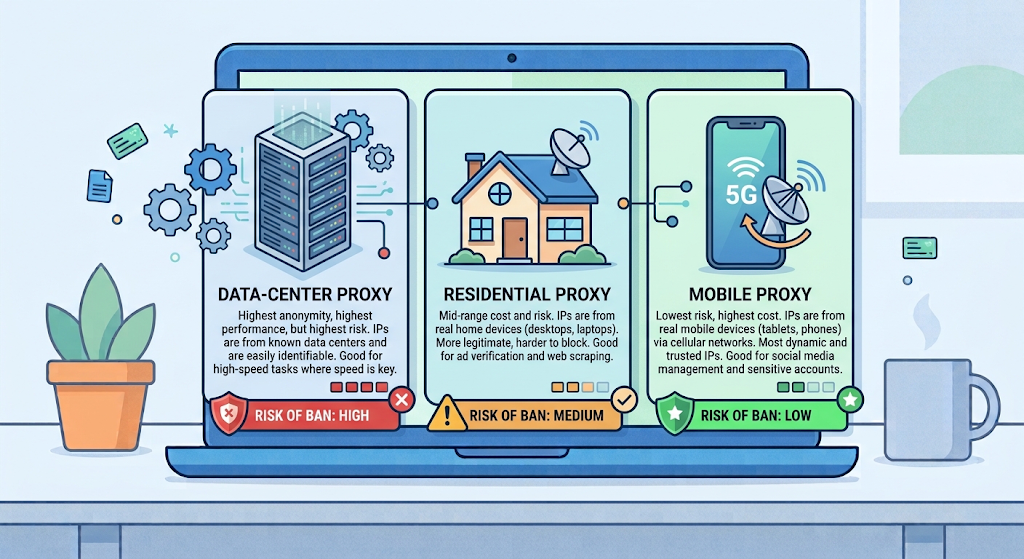
Even the most accurate filtering logic is meaningless if all traffic goes through the same burned or data-center address. Anti-fraud systems and moderators check the origin of the IP first:
Data-center addresses are calculated almost instantly—databases like IPQualityScore or IP2Location immediately mark them as hosting-related, and the platform automatically classifies such traffic as suspicious.
Proxies with a bad reputation, already burned in spam databases or used by thousands of other clients before you, are banned in batches—you inherit someone else's history of abuse, even if you didn't violate anything yourself.
Shared addresses without rotation quickly hit limits—an atypically large number of requests from one IP in a short time is a trigger for blocking.
The solution is individual residential or ISP proxies linked to a real home Internet provider, not server infrastructure. For the platform, such an address is indistinguishable from an ordinary person who just logged into the network from home.
What to Look for When Choosing Proxies for Cloaking
Individual "one-hand" issuance. If dozens of other clients use the same IP simultaneously, you get not only their traffic but their ban history as well.
Address type. Residential and ISP proxies linked to real ISPs look organic to any anti-fraud system, unlike data-center pools.
Geography. The ability to choose a country and even a specific provider directly affects how natural the traffic will look for a geo-targeted campaign.
Stability and speed. A slow or dropping proxy doesn't just ruin the user experience—it increases the chance that a real visitor will leave the page without waiting for it to load, and you lose the conversion before the cloaking even triggers.
Don't chase the lowest proxy prices: the cheaper the pool, the higher the chance that someone has already "burned" the address before you, and it's already on the blacklists of the platforms you need.
How Cloaking Looks in Practice
Even with properly selected proxies, writing and maintaining filtering logic manually is labor-intensive: you need to constantly update databases of bots and spy services, monitor new moderation detection patterns, and keep analytics for each flow separately. That's why most media buyers use ready-made cloaking platforms where this logic is already configured and updates automatically.
For example, XCloak handles bot filtering, spy services, VPNs, and data-center address filtering, and also provides live click analytics—how much traffic went to the white page, how much to the real offer, from what GEOs and devices. You can manage multiple flows from a single dashboard without writing filtering rules manually or dealing with code.
Conclusion
Cloaking for a beginner is not one secret script that "just works," but a bundle of two equivalent parts: competent traffic filtering logic and a clean proxy infrastructure underneath it. Even the most precise cloaking rules won't save a campaign if the IP addresses through which the traffic flows are already burned and blacklisted. Start with verified individual proxies, and build the flow logic on top of them—then both parts of the system will work for each other, not against each other.